Sunday, November 2, 2008

Going My Way? How to Travel to Modernity

I remember in junior high being shocked when I learned that in the Middle Ages the average person didn't travel more than 12 miles away from their birth place. Ever. In their whole lives. And now I'm living in such a place.

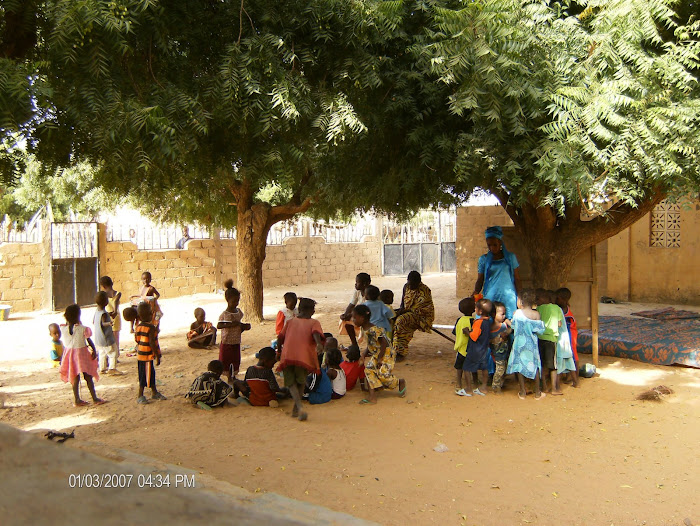
This is our front yard.


Just to get here-- to Kaedi, internet, electricity, American cooking, and you-- I have to travel an arduous, tiring, haggard, and nearly impossible whopping 65 kilometers! Thats all of about 40 miles, less than the commute for most Californians on their way to work.

To begin with I'm really not bitter about any of this at all, it is part of "learning patience." That being said, whenever I feel the remarkable mother-child powers calling me to a beloved package that has arrived at the Post Office or sense your need to know more about life in Mauritania, I have to plan on spending the day in transit:

Usually around 6:00am I will get up so that I have enough time to pick up my bed, get dressed (no bathing since it's still dark and thus not safe to go bathe, or its too cold now), walk to the neighbor's house to buy fresh bread, walk back home, eat it, grab my bag (only one outfit needed for 3 days, everyone does this), and walk out to the "road." The "road" is about 5 minutes walking from our house and is actually tire tracks embedded in the sand that drivers don't actually need to find Kaedi. No pavement, no trail, and no guidelines whatsoever. (During the rainy season most of it is flooded, so to pave would be pointless for a quarter of the year).

You can see the camels "following" the "road" on an early morning walk.


Ok, so I'm chilling on the side of the road, maybe sitting on my bag, maybe alone, maybe with some other traveling Tokomadjians, and I'm waiting. From about 7:00am or so, just waiting for the next passing truck. Once I had to wait only 5 minutes, but another time I waited 2 hours. As soon as one comes down the "road" going in the right direction, they see me, I stick my hand out to show that I DO want to get on the truck, and the driver and I will negotiate a price for my passage. Even though we all know it's 1,000 UM (ouguiya, say it: uuuu-GEE-ya) (about $4.00 USD)to go from Tokomadji to Kaedi, we all know we have to barter. Drivers may say it's up to 5,000UM, but as long as I just insist that I'm going to pay ONLY 1,000UM then after about 2 minutes of repeating myself, they agree that yeah, it really is just 1,000UM. Done. Unless I have really big bags, then that's extra.

Of course the simple 3 seater Toyota with no cab or bed extensions is already full inside the cab, and all kinds of 50 Kilo sacks of rice, sugar, luggage, and people have filled the bed, but this is not meant to discourage travelers! I just hike up my wrap skirt (I'm sure to wear underwear on travel days!) so no one sees above my knees but I can still hike up the wheel of the truck and climb onto the bed of goods in the back, wedging myself between a stinky shepherd, a student, an imam, and a nursing mother. Quickly I try to twist my fingers around anything semi-stable while not invading anyone's privacy and keeping in mind my own safety, anchor my butt (the bulk of my weight, I mean, the center of my gravity), and wedge my feet under luggage or dangle them over the edge. Sometimes everything is covered with netting like fishing nets, so theres an automatic handle right where you're sitting!

You can see the nets by my feet! I was lucky in this photo, no one to squish against!


Ok, my fellow travelers: the shepherd spends most of his days alone with his camels, cows, goats or sheep in the countryside away from any sort of civilization. He likes to wear a ridiculously long (like 3 yards) scarf on his head and mouth to protect it from the sun and dust. He usually has some billowy pants that are a cross between gaucho pants and sweat pants (super light, big, airy, and tight on the cuffs), and a poncho-shirt that looks like Great-Aunt Mabel's old curtains (big, colorful flowers, etc). He's nice, sometimes talkative.

The Student is the embodiment of the West meets Africa or Africa abducts America: jeans (that say really funny things on the leg in English like "Use only non-chlorine bleach. Tumble dry low. Warm iron if needed"), sunglasses (cost about 300UM, or $2 USD), back pack (jansport knock off), and shirt that must pay tribute to Bob Marley, 2Pac, or any national soccer team (usually Brazil, go figure!). These are the boys that you can just see walking down a street in LA and totally blending in...sort of.

The Imam, or other professional religious person is almost always very interesting in what I believe, willing to share what Muslims believe, and usually very friendly. I like him!

This is what we see sometimes: a random canoe (the only river-traversing method).


The nursing mother always worries me. We're on this ridiculous, non-existent, ravine-ridden road, and she has this 8-month old balanced in her arms, suckling as she's trying to keep him from sloshing around too much as we bounce down the say. Somehow I am always next to her so I always try to let her lean against me since both of her arms are on her baby, not holding either of them to the car. She's usually pretty quiet as she tends to the nursing child while trying to semi-hide her exposed body part.

As we go along we pass several waiting people, sometimes stopping to pick them up, sometimes not even slowing down, and sometimes letting people off. This ALL could potentially happen in a village--like my case-- or in the middle of nowhere, which I'm still piecing together. There is of course a strategy to getting the best seat: the closer to the cab the less bumpy the ride; the more in the center you are the more you can lean on others knowing you're not going to fall out (but really its not cool to touch the others, so no leaning on them). If you're on the side you really have the potential to be jostled out of the truck! Oh, and we've squished about 20+ people in the back of the truck, on top of the goods.

This is exciting, right?! Good! This trip lasts about 2.5 hours on a good day. Yup, just to go about 40 miles. And its all worth it: about 11 or 12 noon we make it to Kaedi! We're all dropped off at the market, I go to the Post office, get that package that was calling me, and head off balancing my bag or box on my head for the 15-20 minute walk to our "Regional House" and little slice of America.

Our front yard as you walk in the door. Sam on the doorstep, Kelby the dog on the mat on the floor.


Sara Cate lounging in the lounge. We have tons of books, a fan, table, foam mattresses for sleeping/sitting/playing/lounging on, a table, and dvd's!

Friday, October 31, 2008

Taking a whiz

Yes, peeing. Pretty simple, right? you walk in, flip on the light switch, have a seat, do your business, wipe it clean, flush, wash and go. Easy.

Oh, but wait! Not in Mauritania!
First you have to find the makaresh, or satela, which could be sitting anywhere in the yard: by the cooking fire, under the sleeping platform, behind the door, next to the garden, on the corner of the porch, under the tree, or leaning against the water cannery, but never near the actual bathroom it self. Once found it is usually guaranteed to be empty. So its back to the water cannery.

At the water cannery there are 2 to choose from: one with river water and one with well water. The well water is strictly for drinking, and river water is literally for everything else, so don't dip into the wrong one. So you grab this plastic, 1-liter, handled "pot" and dip it into the river water cannery. Oh, but only use your right hand to hold the pot because the left is dirty (more on that to come ;). Pour the water from the pot into the teapot-shaped satela. I've been yelled at several times for doing this wrong:

you have to have to have to pour the water away from the cannery's opening. Not over it. The satela is after all dirty from going into the douche/bathroom, and if water drips from it into the cannery then the cannery is dirty too.

Ok, so you have your water. Make sure you have shoes on! Walk over to the bathroom, be careful because the door doesn't actually close all the way: I've been walked in on a few times... Try to close the door as securely as possible, walk over to the hole. Time to go, right? Nope, not yet! Since the door doesn't really close, and people have accidentally come in, its best to consider which way to face: if you face the door, everyone will see your junk. If you face the wall, they'll just see your back and knees poking out. But the hole is best reached if you face the door. So if it's #1 (peeing) face the wall! But if you have some real business to attend to, you'll have to really close the door as tightly as possible!!

Once you're in position, aim well! And remember that anything that doesn't make it in the hole, you're responsible for. Once you're relieved, use that pot of water! Right hand in back, pouring (but don't get your clothes wet), left hand in front for the balance (remember you're squatting over a hole, you don't want to fall over). When all is clean, stand up, still wet (we don't really wear underwear, that would be a natural nursery for diseases), and hopefully there's still some water left after your escapades, because I still like to use soap to wash my hand.

Usually there's this little scrap of soap up on the wall of the roofless toilet room, but it is a little taller than me, so I have to reach up, feel around, and try to find the little bugger. Then wash my left hand with just my left hand, so that my right hand can pour out the water. I usually do this over the hole so that any thing that may still need to go down the hole goes down. Put the soap back up on the wall, open the door, you and your wet behind are finished!

Deposit satela wherever you think the next seeker will most likely not find it, and go some place where either 1) your butt will dry while you sit down, 2) you can stand if the fabric of your skirt/pants/etc. doesn't show wetness, or 3)go for a walk

Hopefully you're not sick and you don't have to face the people that heard your explosive diarrhea and/or gas as it erupted into the echoing hole.

I realized that I have had to learn a lot of patience with my self as I learn how to do everything over again: talk, walk, greet, stand, sit, lay down, sleep, eat, drink, bathe, address people, cook, clean, sweep, read, write, do my hair, wear my clothes, sew, buy clothes, go to the market, shake hands, answer the phone, count, pay rent, fend off marriage proposals, joke, laugh, visit friends, make friends, know people, and yes, even pee.

Friday, October 17, 2008

These are a few of my favorite things....

Yesterday we had some visitors from the European Commission to see our health volunteers at work. Among the 6 visitors were a few Frenchmen, a couple Italians, and a Spaniard! They didn't stay very long, but we did have great conversation, exchange phone numbers, and speak English (a rare treat these days). Then the Italian invited me, along with all of the other local PC volunteers to his house for a get-together/ party (can we call this a party?) So this morning I got up at 5:30ish to pack and get ready for the 2-3 hour trip into Kaedi. After going around the market, greeting, talking to nice random people, bargaining for cooking oil, eating for the first time in a Mauritanian restaurant (on the floor, just like at a friend's house, we just had to pay afterwards), and buying oranges (we don't have any fruit in my village), I made it to our "PC house", found 3 packages waiting for me from my mom, AND was promised spaghetti for lunch! I was so happy!
My mom sent me Oreos and as we sat around eating them, we couldn't stop laughing, giggling, smiling, ohhing and aahhhing, and marvelling at the deliciousness that is the Oreo!

Some other weird new things that make Mauritania very enjoyable:
the smell of burnt tea
fresh bread in the mornings
watching people pray
bathing 2 or 3 times each day
talking to everyone I meet in my village
everybody knows my name! it's better than the TV show Cheers !
drinking Tufam! (soured milk mixed with water and sugar...amazing.)
Friendship bracelets
sleeping outside
eating outside
sitting on our raised bamboo platform called a donkey, talking to my host family
the joy people have when I take their picture
hearing my family try to speak English
understanding Pulaar!
sharing American candies with my family--they love it!

Africa is definitely NOT as savage as many Western people think it is. Yes, its dirty with trash in the streets, we do everything outside, and kids are always running around half--or completely-- naked, but people are still loving, educated, striving for improvement, and doing the best possible with what they have. This is definitely a place that more people should come to see and understand.
You always have a place to stay if you come to visit me!!

Saturday, October 4, 2008

Day 106 in RIM--and I'm still here!

But of course I’m still having a great time in Africa. Haha, I totally get these reality checks sometimes and realize I’m IN Africa. Just the other day we were sitting in our “Peace Corps” house (a house for us to stay in when we come into the state’s capital) and saying, “You’d be surprised what you get used to.” And its so true!
I’ve been in Tokomadji for one month now, exactly the month of Ramadan. So I never knew what this entails, and it is sooo intense: from the night the moon disappears through the new moon—30 nights—all adult Muslims are required to Fast, meaning no food or water during daylight hours. Even in the crazy African heat, NO WATER!! I found out there’s a science to Fasting correctly: at 5:30ish everyone wakes up to the call in from the local Mosque, makes some breakfast, usually a porridge called ruy (pronounce it like you would in French, but with a rolled “r” or say it: ru-ee) and/or bread and coffee/tea. Once the second call is out from the Mosque announcing the official rising of the sun, NO MORE EATING OR DRINKIG ANYTHING, say your prayers, back to bed, then get up later to go to the fields to work.
Another interesting thing: field work. Going with my family to “weed” the fields made me so thankful that I was an athlete for all of my life, and that water was my sport. There is no other way that I could have kept close behind my fasting family. It’s bending over with a hand-held hoe from about 8:00am-noon. Of course they all are so much better at it than I am, even when they’re fasting, but I was at least able to semi-keep up. The whole time I would think of college water polo practices, and Rond saying that we’re swimming our yards when we’re tired to be ready for that fourth quarter of water polo play. And I would keep going in the field. I would totally be laughing, thinking of where I came from and where I am now, but I would keep going, relishing of the excellent cross training I was getting.
So after being shown up by my fasting host sister we’d go home, “shower” (you’ve seen the makaresh, right?) rest, then work around the house in the evening once it cooled down. Around 7:00pm, the Mosque would announce the official sun setting, and we’d break fast! Dates, water, and bissap to whet the whistle, then coffee or tea with bread (kind of like a regular breakfast). About half an hour later we’d have a dish of potatoes with meat or fish (kind of like a normal lunch), and around 10 or 11pm, once the food has digested a bit, we’d have rice and fish (kind of like dinner). I always saw breakfast as getting in the full day’s meals, all in the same order, just after dark.
Its required by the Muslim faith to fast, and I was told they do this for two reasons: 1. To cleanse the body of any impurities and 2. To feel the pain and suffering of the poor that have to live through this for their entire lives. The really old, the really young, the sick, and pregnant/nursing mothers aren’t required to fast, so I still got lunch with the kids in the family!
Basically during Ramadan any work that doesn’t need to be done isn’t. So many, many people spent their days sleeping, resting, and trying not to sweat out their water reserves.
Other things I’m –still—getting used to:
People always like to ask me about the United States, everyone wants to go there, and daily I’m asked for a Visa to the US.
Even my forearms sweat. It is so gross.
Getting marriage proposals, from random strangers
Being told why I’m going to Hell (not by all people or even every day, but when it does happen I’m still a little weirded out by it)
Not understanding everything that people say to me.
Being patient with myself as I learn something new.
Recognizing the cold wind that comes 2 minutes before heavy rain fall, and trying to pick up my bedding, etc before the rain gets here!
Strategizing my eating plan so that I get enough meat and veggies before they’re all eaten up by everyone else at the plate.
Keeping a good hold while in the bed of a very bouncy, very fast pick up truck so I don't fall out
Well, life continues and I honestly and absolutely love the support I get from you! Hearing from you in any form is the highlight--and main reason--of leaving the relative paradise that is Tokomadji to come into the city!


Twin! I miss you so much!

Monday, September 1, 2008

Pictures

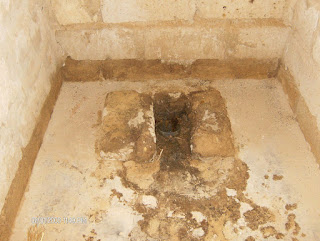
(1) This is the toilet: a nice hole in the ground about 5 inches in diameter and 2 bricks on either side to put your feet. Everyone squats at these things, even men!
(2)This is the "shower" See the little pot with a handle and spout? That's the makaresh that holds about 1 liter (or less) of water. That's what I bathe with.


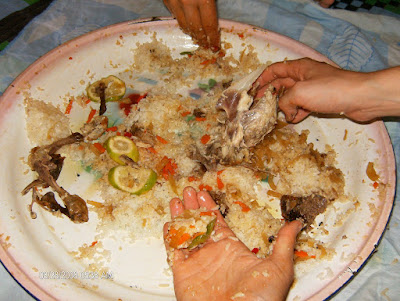
(3) This is eating! We only have 6 people at this plate, usually there are about 12 for a plate this size. See the toes on the right? That's because we're all sitting cross-legged on the floor!


(4) Same plate just a few minutes later. My hand at the bottom is giving a sample food ball: rice, veggies, chicken all mixed in and squeezed tight to fit in my mouth.


(5) Same plate again, with Tanya on the left, Sara Cate (my CBT site mate, Gorgol region mate, and close friend), and me eating on the floor.


(6)This is my neighbor's suudu, a typical room made of twigs (say it: Sue-do). Right here the grandma, cousin, and daughter are making/eating breakfast. This is where they eat breakfast every day.


(7) This is Hawa (Say it: how-uh), my friend's host aunt. She's in the village's boutique, which is owned/ran/operated by her part of the family. That's pretty much all of the boutique.


(8)Inside a suudu is my great friend Daya (Say it: Dye-uh) and her youngest child. Notice we're all sitting on the floor. Every household has a suudu or two, and every woman is in charge of making her own. It's really cool though because once it's at a certain stage in the making, all of the village women will come to help finish it.


(9) Lastly is the place I go every day: the bathroom! On the left is the shower, on the right is the "toilet". This is a really typical layout for the bathroom here. Washing hands afterwards is using the rest of the water in the makaresh and some soap (if it's available) pretty much anywhere you feel like washing: by a tree, in the middle of the yard, etc.

Saturday, August 30, 2008

Right most of my classmates from school are now either working or going to grad school; it all sounds interesting but hard; I was planning on going there one day, but right now I'm not so sure. I'm really loving the Peace Corps so much! I feel like this is the simple kind of living that I've always dreamed of for myself.
I just finished training and on Monday I'll be going to my final/permanent/for real village that I'll be living in for the next 2 years. So I'm not even sure yet what my daily schedule will be like, but this is what it's been for the last 10 weeks:

Get up 7am
go to the bathroom: a Turkish toilet/squat outhouse and use water/hand
wash my hands and face
go to the boutique for bread
drink tea with the bread
clean my room
sweep the patio
clean up the yard
go greet people/hang out/ talk
come home and make lunch 12ish
eat lunch 2ish
drink tea, talk
nap during the heat, until about 3pm
go to the ONLY water spigot in our village and bring back water for bathing/drinking/cooking
do whatever work may need to be done, like helping my aunt build her twig hut (very hard, and I really can't do it very well!)
shower
go greet, talk, hang out
home about 6ish to help with getting the cows milked (I don't actually do the milking)
drink some fresh milk
strain fresh milk
put fresh milk into container to be taken to a factory on the "milk car" which picks up the entire villages milk containers
play with my cousins, teach English to my aunt, start making dinner
eat dinner 9ish
go greet, hang out, talk
bed 11pm

In my new home starting on Monday I have to get my water from a well every morning! and I can balance it on my head! its so awesome to do all of this. we don't have electricity, running water, a doctor, a road, or very much at all really, but we laugh often and love a lot. so its worth it to me.

For 10 weeks I was learning Pulaar and the local culture. I was in the site with 4 other Peace Corps Trainees and a local teacher; each of us had a different host family where we slept, ate, studied, and lived like exchange students. Now that we've learned the basics we've all gone to our separate regions within Mauritania. Regions are like states: in the US there are 50 states, each with its own capitol, characteristics, and customs. In Mauritania there are 14 regions, mine being "Gorgol." I am so happy because my really good friend Sara Cate, or as the natives call her Suli Kay (they can't say her name well), and I are in the Gorgol together! That doesn't mean we'll be together all the time because the villages we live in are about 100 kilometers away from each other.

Now we've arrived in the Gorgol to buy the necessities for our homes for the next 2 years, including:
floor mat
sofa cushion-like bed
3 buckets for bathing, getting water from the well, etc
2 tubs for washing clothes, getting water from the well, etc
cups with handles, for dipping into the buckets and/or tubs
gas stove
water cannery, for keeping drinking water in
cooking pots/pans/spoons
bamboo cot
sheet
hand broom
makaresh (the toilet)
hand fans
bowl for eating in
and anything else that looks cool

Ramadan is starting, so everyone will be fasting during the day, meaning NO WATER or FOOD while the sun is out. Except for children, feeding mothers, and me. If you feel moved to send just-add-water foods to help sustain me, feel free!
brownie mix
baking mixes
oatmeal
bacon bits
Crystal Light juice mixes
your love

Let me know if you have any questions about Africa and I'll answer them!

Sunday, August 24, 2008

I can’t believe I’ve already been in Mauritania for 10 weeks! They’ve gone by so fast! I just left my training site PK-6 and in about 4 days we’ll be sworn in as the newest Peace Corps Volunteers in Mauritania!

Anyway, for the last 10 weeks 4 other Peace Corps Trainees—PCT—and I were in PK-6 to learn Pulaar and the African culture. Today we left PK-6 in a flurry of tears, hand shakes, hugs, and promises to visit. We all really love PK-6 and it was hard to leave.

Sanitation is interesting here: ok, so its almost non-existent to the American standard. In the Muslim religion there are 5 prayer times a day and each time the person praying needs to wash their face, hands, and feet. This is really practical since everything is not very sanitary: kids play in the dirt, next to the spot they peed in earlier in the day. Cows, goats, chickens, donkeys, dogs, and cats roam everywhere, including the yard. Everyone spends pretty much al their time outside since inside is just way to hot. We spend our time under an “mbarra” which is a low roof with no walls: shade and the breeze!

Anyway, everything has fine amount of dust in/on it, even the food! Food is good here, but it gets monotonous: rice, fish, and veggies every day for lunch. The young girls about 13-18 start cooking about 1-2 hours before eating, usually inside a small twig hut over a wood fire. When its ready, they spoon the rice into a huge bowl then strategically lay out the fried fish and vegetables all around, put the bowl onto their head, and walk over to the mbarra where the family is waiting. There’s a piece of cloth put on the floor, usually about 3 sq ft where anywhere from 8-15 people gather around. One of the 8-15 year olds, or who ever is “low” on the family totem pole will pour water out of the makaresh (which looks like a big tea pot) so each person can take their turn to wash their hands. Usually there’s soap but some times not, so that can be disgusting considering all the hands you HAVE to shake, the animals you’ve shooed away, the dirt we all do everything on, and the fact that your left hand wiped your butt that morning.

Then, all of us gather around the big food bowl and dig in! Right hands only, or use a spoon with your left. You have to grab a handful and ball it up in your fist. Try getting a piece of wonder bread and making it into a ball using just your right hand. Easy? Good, now try doing that with rice. Ha ha he he ha! Please tell me if/when you do this, so I can laugh!

When you’re done you get up, wash your hands, lounge around, and wait for tea!

I love it!