Tuesday, March 3, 2009

And the Winner is....


The things I'm MOST excited for when my family comes:

1.Seeing the joy on Gogo Penda's (my local mom) face when she meets my US mom.
2.Watching the shock and final understanding of my US family when they meet my Mauritania family and see our home.
3.Teaching my mom and dad how to properly squat over the poop hole (you know, so they don't fall over, pee on themselves, or...miss)
4.Laughing at my sister trying to sweep the dirt with that puny little hand-held broom.
5.Showing "the women" aka Kelsey and my mom, the way to balance 10-20 liters of water on your head, walk up the steep river's bank, get to our house, and pour it all into the cannery...without spilling any on your shirt.
6.Letting my dad help kill, butcher and eat a goat. hahaha, hehehe.
7.Waking up with my sister next to me, at sunrise, dragging her tired butt off of the bamboo "bed", and showing her off as we go buy the breakfast bread at Mary's house by the Mosque.
8. Showing how Mauritanian women don't use tables for cutting, cooking, preparing anything... The knife is so dull that your hand is all you really need for everything: chopping onions, preparing meat, peeling potatoes, etc.

9.Hearing the "local-English-teacher-who-has-never-actually-left-Mauritania" try to speak with my grandma....even HE speaks better English than my grandma! (yeah, he still doesn't believe me when I tell him that....)
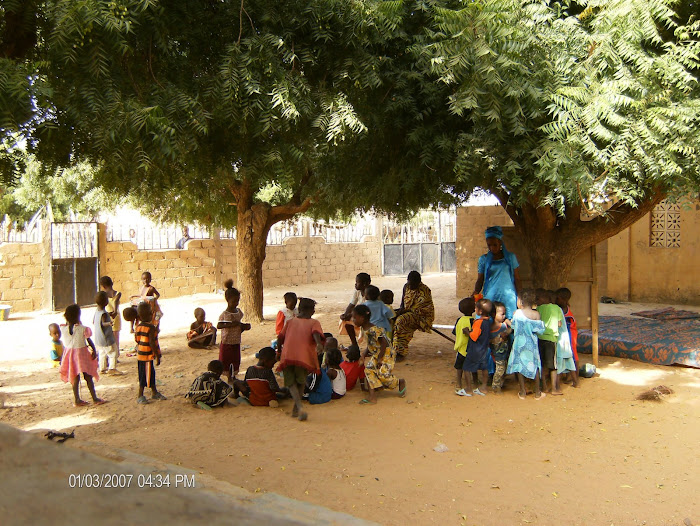
10.seeing the joy on their faces when the kids start to drum and dance around my family... or the fear!
11.Loading baggage, suitcases, and family into a canoe to paddle across the river to get to our village as the sun is setting.
12. watching the wonder as Africans learn that "America" does not mean the United States alone, nor does it mean "white"
13. Helping my parents eat dinner with their HAND. from a BOWL with like EIGHT people around it!

14. Making the parade through town to show off my family to my new (Mauritanian) family and friends. You know they'll be taking pictures of the first-ever entire American family to come to Tokomadji.
15.trying to teach my mom, grandma, and sister how to do laundry by hand so that it squirts water out and squeaks as you wash.
16. BATHING IN THE RIVER!!! without showing anything from your armpits to your knees


17.Putting these CLOTHES on my family!


18.Getting their hair braided and their hands/feet henna-ed. It'll take at least 3-4 hours of just sitting really still.
19.Letting action-based, pantomimed relationships form that will transcend culture, age, ability, social status, distance, and language. Seriously half of the village already knows the FULL name of each person coming to visit... along with their age, job and/or school year, types of food they like, and favorite color. They're excited!
20. being the connection that allows people new experiences: priceless.


Friday, February 20, 2009

It's Not a Third World Paradise


With my parents getting ready to come out and visit me in Tokomadji (that's right! they're coming here! and my little sister...and my GRANDMA!!!) I'm constantly thinking of things that I will have to tell them to prepare them for a week in an African Bush Village. I know that I love being here and have learned to look past a lot of things that would bother most Americans, but how do I explain things like asking for gifts (ie your watch, hat, clothes, shoes, etc) from random strangers is totally acceptable? Or "washing" your hands before eating with them doesn't always include soap? And I know the bathroom sounds funny, but really, we're in Africa! Most Americans can count the number of monthly solid #2's they make on one hand!

So really this is for my mom, grandma, dad and sister:
As visitors expect to be ripped off at the airport getting your taxi.
Next, if you thought those 10 hour drives down to Baja were intense, just wait: at least you have your own car, snacks, air conditioner, music, space, and you've all showered within a 36-48 hour period. In Mauritania the ride is about 15 hours, squishing 10 non-deodorized people in the 8-seater, no music, snacks if you brought them and don't mind them being on your lap the whole time, broken seat belts, windows down, a cracked windshield, and random pee stops behind bushes with no toilet paper or water. And you'll probably be mooning someone somewhere! I think we'll rent a 7-seater for the 5 of us.

When we get up to Matam, Senegal to cross into Mauritania, I'm not really sure about the timing: boats usually stop when the sun goes down, but we may be getting there after that. I'll have to ask a local boat owner (and find out who it is!) if they can be ready for our phone call to come pick us up. When we get to Tokomadji the kids will be clamoring around, touching and hugging everyone, offering to be the best kid possible and carry all of your bags up to our house. Of course little 7, 8 or 9 year olds are going to try to carry your big 50+ pound bags ON THEIR HEADS. And they can do it, too!

My family will all be so excited to meet you guys! Mama, my 21 year old Mauritanian brother, is convinced that my little sister in the US is made for him. Penda, my host mom blesses the woman that birthed me, and I'm sure will be all over her new best friend. Uncle Siley (mauritanian) has been learning English pretty much since he found out my family is coming, and will be so eager to try out his new skill with my dad. And Mama Fati (the very old, grandmother next door) I'm sure will be ready to host my grandma and make sure her fellow senior citizen is going to make it in this place.

We'll eat:
gosi (say it: go-see)(kind of like rice pudding, but a little different),
couscous and milk,
couscous and boodi (say it: booty) (like a soft cucumber),
haako (say it: haa-ko)(bean mush, looks like baby poop),
rice and fish (the usual),
maafe (say it: maa-fey)(on rice: vegetable sauce with spices),
kele kele (say it: kelly kelly)(better-than-American- sweet potatoes cooked in a salty sauce, served with fish),
vermisil (gross pasta served in oil. that's it),
niri (say it: nee-ree)(over-cooked rice that sticks together with a tomato base. It's dipped in pure, freshly made cow's milk oil.)

Eating is the coolest thing: All of my friends will be over to greet and meet you, so they'll stay for lunch (probably). But of course having so many people over is hard on the family, so their respective families will send over plates of food from their own households to share with you, show you how good the food is, and show that they honor and respect you.

Remember, it's not a third world paradise! Your stomachs will then be so upset at you, run like crazy, and even disturb your mosquito-filled nights. We'll be going to the wells and the river to get water for ourselves, sweeping the dust in the mornings, filling our noses with nastiness, and sweating worse than a fat kid running. The hot season will be starting, people will be asking to be sent to America, asking for marriage (either me, Kelsey or Dad: he could use another wife or two, right?), laughing at how weirdly we do things, and expect us to be unable to do pretty much anything.

Leaving will be a sad affair: people will be sorry to see you go, and waiting for your next visit.
Any questions about the itinerary?

Wednesday, January 21, 2009

Djenaba's Travels--That's Me!


Did Djenaba ever travel! (the D is pronounced like a J; my name is said: Jen-uh-buh, or read it like it's a name in Spanish)
For the past month I have literally traveled half way up Mauritania and half of the entire width of the country for the holidays, training, and visiting friends' villages.
The first amazing thing is the car ride from Kaedi to Nouakchott: 8 hours to go 400 kilometers! On the bright side we had some sheep going with us on our taxi ride and I was able to share with 11 Mauritanians their first ever Oreos. In our 8-seater Volkswagen we had the standard 11 riders: three in the front seat, four in the middle row, and four in the back row (and of course the 2 rams!) It's always interesting being a white, Christian woman in the Muslim Republic of Mauritania: as a woman I should be in the back (thus going along with the popular view that men are of greater status than women, who should be obedient), but as a white person it's obvious that I'm not African, so I'm a guest, and they'd like to treat me extra special to show that they appreciate having a guest. But I'm still a woman. So on this particular ride I was in the very back row, but the 3 others were sure to give me as much room as possible. (Though it could also be due to the fact that a man was sitting next to me, and he's not religiously allowed to touch me. At all. Even in a car.)
Being in Nouakchott was like being in Ensenada or Rosarito (Mexico): restaurants for the Westerner's tastes, huge buildings made by private international organizations, people walking around in all kinds of western clothes, all mixed in with the trash every where, dirty little hole in the wall cafes, dusty kids holding out their cans asking for money, and the strange dichotomy of wealth living with poverty.
But we did eat hamburgers, pizza and Ben & Jerry's!

After Christmas with the PCVs in Nouakchott (including my friends Sara Cate and Ava, as seen here), I spent the New Years with my host family from training in Rosso. New Years, or "the 31st" as its called here, was apparently outlawed by the government in the 90's, thus forbidding large parties or celebrations as they are not officially on the Muslim calendar. This was explained to me just before Midnight as we sat on the ground just outside the house. There was a small party going on in the next village over, but none of my friends or family went because, in this culture, married women don't go out at night without the husband's permission, teenage girls (the ones that aren't married yet) don't go out unless they want a tarnished reputation, and the men can do as they please. So we brought in the new year with me learning about life here as we ate tangerines under the stars.
Seeing my host family was amazing! I got to experience real Pulaar hospitality. First everyone is ridiculously excited to see you, running out to the car, giving hugs, holding your hands, carrying your bags, women and children touching your arms, back, legs (for the shorter kids), just to stay near you. Fresh milk is brought out, tea is made, the questions about health, peace, family, friends, work, life are never ending as they want to be positive that there is "only peace" in your life. Getting there in the afternoon it was a given that I'd spend the night, so me and Mariam shared a huge blanket on our side-by-side matelas. (Sleeping is according to gender and age: there are so many people in one household with three rooms, so we split it: mother and little children in one room, teenage/unmarried women in another, and young men in the third). I knew I'd be staying one night, so I brought just my tooth brush, face wash, and deodorant. (Everyone lives and sleeps in the same clothes for 2, 3, 4 days), but when I was trying to leave the next day, they were so kind, welcoming, and insistent that I stay longer... so I stayed 3 nights! And they were still sad to see me go on the 4th day!

After several days of agricultural training with the Peace Corps, I headed East to Selibaby with two other volunteers to see their region, the capital, their villages, and their gardens (always work related!) Because the only way to take paved roads in Mauritania would take us north 6 hours then back south 8 hours, we decided to go straight across, in the most direct line possible, which is only available through Senegal. 2 days, a ferry ride, 6 cars, 1 metal bed for 3 people, lots of waiting, and one canoe ride later we were back in Mauritania, about 200 miles to the east of Rosso!

Selibaby is right in the "crotch" of Mauritania, the little dip that is bordered by the Senegal River: the Sahel is in full swing, baobabs abound, and I was singing the soundtrack to the Lion King about the whole time. Tim, Shelby, Sari and I climbed a fallen baobab tree as the sun rose in the cold morning--yes, it IS cold!

Later that day Tabatha, Tim and I went out to Koumba Ndow (say it: coom-bun-dow), Tabatha's Soninke village to see an Ag/fo volunteer's dream: huge, lush gardens, shallow wells easy for getting water, motivated people, and budding fruits. I even spoke Spanish with about 5 or 6 guys that live/work in Spain!
After 2 nights in Koumba Ndow, Tim and I went to his Moor village, which is only slightly changed from the traditional living from hundreds of years ago. Firstly, they have a phone. Secondly, they no longer move their tents, but use mud bricks to make a sturdier, longer lasting tent frame. Thirdly, they have wells.

The coolest thing about going all over, visiting 3 different cultures, and meeting so many people is seeing that although the Pulaars, Soninkes, and Moors are all distinct, they are also similar in certain ways: the hospitality, giving nature, curiosity about foreigners, and overall kind heartedness.


Can you find the Pulaar, Soninke and Moor women just by looking at their clothes? Hint: Moors use a mulafa (say it: moo-laa-fa), like a sheet, to completely cover everything but the face, hands, and feet. Soninkes have a head wrap in addition to a shawl, as do Pulaars, but they also have different kinds of facial scaring for beauty.

Tuesday, December 23, 2008

I'd like to tell you a story...

So I have a field. Not the "hills are alive with the sound of music" kind where little birds and bunnies frolic merrily by your feet. No, this is the work-for-your-food and pray-that-you-harvest-enough kind of field. It's four plots, each roughly 30 feet squared.

When I first got to Tokomadji my host mom Penda would take me to the fields to show me how they "weed" the fields, we'd work together with her two sons (Mama, 21 and Demba, 12), and it was a good learning, bonding, working experience for me. I had to learn how to distinguish between the grassy weeds and the tiny shoots of millet that look pretty much identical to the weeds, and how to recognize bean leaves--then not kill them. It was great! Then about two weeks into it we're out in the field when Penda turns to me, earlier than usual, and says, "Lets go home, I'm tired." I told her that I wasn't tired so if she wanted to go home, go and I'll stay to finish the parcel that was left. She said she didn't want to leave me, so we both stayed until it was done.

That night, after spending the afternoon puking and feverish, she was officially diagnosed with malaria. The next day, not knowing what to do with myself, I went to the field and kept weeding. For 10 days I was the only one to go to our millet field (Mama and Demba, both still considered children in this society--and act like it--didn't go because their mom didn't tell them to). Of course what took me 10 days would have taken any experienced person about 2 or 3, but at least I was kept busy!

From then on, Penda's been referring to it as "Jenaba's field" (that's my local name! say it: Jen-uh-buh or Jenna-ba). After not going to the field for a while (the Muslim holiday Julde, I went to Kaedi, had an ear infection), I came back to find the little ankle-height shoots taller than me! I was totally lost in the cooperative's fields and couldn't find "my" field: Penda had to show me where my babies were!

Just when I thought I had seen it all, it came time to water my little ones. Oh, my gosh, what a job! A rusty water pump on the Senegal River is heard throughout the whole village as it pushes tons of water up the river's bank (about 25 feet) in huge pipes to the canal system so it can flow into each man's field.
(Yes, I said each man's field: only men are allowed to own a field in the village's cooperative. We have three fields: Penda's deceased husband's, her uncle's, and her father's. None of which are next to each other). Watering goes by sections; within each section each person allows the water to go past their field and those furthest from the pump open the small door to their field to let the water in. Once their field is thoroughly flooded, they close their door, stopping the flow to the field, and the next person opens the small door to their field, and so on until all people in a given section of the cooperative have watered/flooded their field.

It takes all morning: watching for leaks in the sand-and-mud divisions between people's fields, faulty doorways, breaks in the canals, people going out of turn, people not paying but still watering, and anything you can imagine that could go wrong! The fun part is taking off your flip flops, hiking up your skirt, and going nearly knee-deep (on me, I'm short) in the mud and water, back and forth the entire length of the field as you check for possible problems, leaks, etc. Ideally, we water once every 20 days or so (which, from an agricultural point of view, is NOT ideal).

Hey, people like millet, right? So do the birds! We had a 3-4 week battle with the birds as they would come and attack the fields and we would defend them by throwing rocks at the little buzzards and yell at them our war cries (literally we yell--birds don't like loud noises!). Again, poor Penda got malaria and I was the only one to come to our field's rescue (this time all of the kids were at school, learning. How can I argue with that!?) I quickly learned the rightways to yell at the different kinds of birds, how to use the "sling shot" (two arm-lengthed ropes connected with a palm-sized piece of cloth where the rock sits. You wind up over head like a lasso cowboy-style, then at just the right spot you let go of one side of rope, sending the rock into the millet, scaring the birds away). Also, the best looking millet got nifty outfits: they were wrapped in cloths to keep the birds out.

Yelling became my favorite part: my friend Djeewo (Say it: je-woah) and I were the youngest out there (only middle-aged women and grandmas came out). We would yell all kinds of greetings in all kinds of languages, sing, yell, dance, shout, and just have a great time even though there were about 2 fields between our own and most of the time we couldn't even see each other!

It was a sad day when Djeewo and I couldn't dance and sing at each other in languages the other didn't understand, but that day came: we harvested. You keep a long, toothed, curved, handled knife in the right hand, grab the head of millet in the left, and chop it off. We'd chop, throw it on the ground in piles, then later collect with huge sacks, and send them by horse and cart to our house. Now the millet is sitting on top of a storage room, drying out, waiting to be stored for eating or local selling later, or shipped to Kaedi to be sold in the market.

Any foods we don't grow in our fields or gardens is bought in the market with the money made from our fields. For lunch we eat rice (or lachiri, a grain derived from the millet we harvest!) with fish (one is 70UM Ouguiya, say it: oo-gee-yuh; we usually have 2 fish for 6-10 people) and veggies. If they're bought in the market it's about 200UM worth of veggeis: 1 or 2 small eggplants, 3/4 cups of tomato paste, 1 cup of Mauritanian pumpkin, 1 cup of Mauritanian cucumber, 1 cup of sweet potato, 5 small okras, a small chili pepper, and 2 onions.

Right now we also have in our field/garden space: pumpkin, cucumber, sweet potato, okra, and a thing we call folere (say it: fol-le-re, pretend its a word in Spanish, and there you go!). I have no idea what this is in the States!
Finally, my field is being harvested down to the roots so that our 8 goats and their 10 kids can eat the leaves and the 2 calves can eat the stalks. Nothing goes to waste!

P.S. When we keep the birds out of the fields, its an all day thing: we go there 7am, lunch is brought to us, we nap, do laundry, bathe, brush our teeth, make tea, chat, and work until sunset around 6pm.


Sunday, November 30, 2008

What is going on here?!

I realized that most of you are probably wondering what is going on here. You know I'm a Peace Corps Volunteer, but what do I actually do?
Peace Corps Goals:
1.Helping the people of interested countries in meeting their need for trained men and women.
2.Helping promote a better understanding of Americans on the part of the peoples served.
3.Helping promote a better understanding of other peoples on the part of Americans.
Sectors: Agroforestry, Girls Empowerment and Education, Small Enterprise Development, Health, Education, and Environmental Education.

Me specific:
Country: Mauritania
Region: Gorgol
Village: Tokomadji
Sector: Agro/Forestry
Ag/fo goals:
1.Fight Malnutrition.
2.Protect the land and environment.
3.Give training to create sustainability.

As PCVs (Peace Corps Volunteers) we are largely ambassadors from the United States to the everyday people of the world, sharing who and what we are. You'd be SHOCKED to know how many people in the world dream of going to the United States to make money, support their families, and build a better life in the Land of Opportunities. So, in response to the large demand, there are countless English classes given by PCVs in all sectors.

In Tokomadji I work in the fields with my host mother Penda, give pedagogical support to the village's first-ever kindergarten, help cement the local English teachers' English, teach English to high schoolers, and promote gardening, composting, and fruit tree management.

Right now I'm working on getting funding for a building for the kindergarten's 50 students, 3 (volunteer!) teachers, and director and sharing all of my knowledge with every person possible to help them with their quest for a better future.

Any ideas? Questions? Comments? Let me know!

Thursday, November 27, 2008

What's THAT?! A grub!

Every day I have to face one of the most humiliating, humbling, most challenging tasks that --here--even babies do better than me: eat. Again, one of those things that sound sooo simple and you totally take it for granted, but in actuality, not everyone in the world EATS the same way as you do. And I had to learn this, the hard way: by trying as an adult.

First things first: the teenagers have finished cooking, they've placed the food in the big, communal bowl, they've laid down the cloth for eating at and they've called everyone to come and eat. As a girl--I'm not really considered a woman/adult because I'm not married, nor do I have children-- its culturally appropriate for me to sit next to other children or women. That's it. Sometimes if I'm with really good friends, it won't matter if I'm next to a man or not, but usually as we're all walking and/or scooting over to the cloth mat I'm already consciously thinking of how to make my way over so that as we sit down I'll be next to the right people. Ok, once we're all there I usually try to be the first or the last to sit down so that the others can really make it culturally appropriate by moving around me, or moving me to the right place. Once that place is found there's the next problem: how to sit down without flashing everyone who's already sitting, sit correctly so that as we're eating I don't flash the people across or next to me, and how to keep my butt from hitting others as I try to squeeze in next to them!

My advice for a wrap skirt is: stand with the right foot closest to the bowl, bunch up your skirt in front of you so that the back is pulled tight around your knees, bend over from he waist, so that your legs are straight and your torso is down, bend the knees, bringing the butt down to your ankles and sit. As you shift your weight to the butt, let your ankles cross in front of you, allow the skirt to give as you achieve your cross-legged position. If all goes well you should be facing the person to your left, and your right knee should be pointing towards the bowl, thus making the right hand reach to the food quick, easy, and short. Sitting sideways is most polite so that more people can fit around the bowl. You could also sit with both feet behind you and your knees facing the bowl as you lean over your legs, but its harder to do if you're a bigger person (like me--well, at least comparatively speaking).
Ok, so I'm sitting next to the nice lady of the house and a young teen is on my other side. One person, usually the eldest child, is in charge of making sure everyone washes their hands. There is a plastic bowl like thing called a ___________ with a (usually) matching satela. The child will place the ___________ in front of you, you put your hands over it, grab the soap from on top, and s/he'll pour water from the satela over your hands. When you're finished you say "yuni" (you-knee), s/he'll stop pouring, and move to the next person. Now its very important to remember NOT TO TOUCH ANYTHING with your right hand now that its clean and ready to eat. If you do, it'll be dirty again and you'll have to re-wash. Usually we rest the wrist on the knee while we wait for everyone to finish.

If that wasn't complicated enough, now comes the really hard part: digging in! Once everyone--anywhere from 6 to 13+ people have all washed, the plate is brought in the circle, and everyone scoots in as close as possible--usually with knees, elbows, or legs all up in each others space-- the host will say "Bismillah" (bis-mill-ah) meaning, "Welcome God" and we all reach in to the pie-shaped space in front of us. The first bite is always just rice, so go ahead and gently scrape off the top layer in front of you, bringing it closer to your piece of the bowl's edge. Be careful! If you dig too much the rice will be really really hot and burn your fingers!


Phew! Rice is accumulated in front of you; next is getting it outof the bowl and just in your hand. Gently cup your fingers and scoop the rice up the slope of the bowl towards you. Most people like to swipe side to side to make sure that all crumbs are collected off of the bowl's side, then use the momentum and pressure to just lift your hand up and away from the bowl! Voila! Rice in the hand! But don't rejoice yet, you're still hungry and haven't even eaten anything yet!
With your right hand only squeeze your hand into a fist, encompassing all of the rice with your hand and fingers. You know you're an EXPERT baller if you can squeeze it and make a juicy, squelching squeak and make some oil drip out!

ATTENTION: THE FOLLOWING IS ONLY TO BE READ BY THOSE OF STOUT HEART AND MIND. THE CONTENTS ARE DIFFICULT FOR THOSE OF SQUEAMISH DISPOSITION TO HANDLE.
The best way to actually get the food into your mouth is to collect that ball of food at the pads of your fingers, start with your tongue at the base of the palm, and lick all the way up, sometimes wrapping your upper lip over the top of your fingers to keep rice from falling off. The first few days of doing this will be slow goings, and rice will fall all over your lap, the floor, the cloth mat, and maybe back into the bowl. But no worries! Everybody's doing it!
A good host will pick off the choicest pieces of meat and veggies from the center of the bowl and throw them right in front of your eating place to show that you are honored and they want you to eat well. If not, it shows you're just one of the family and you've got to get your hand in the pile of food quickly, pulling out your bites of fish/meat or veggies as you go.
Possible challenges: the bones in the fish (you have to squish the meat in your palm with your thumb, looking for the bones, then pull them out with your left hand, depositing them on the cloth mat in front of you), small pebbles that weren't properly sorted before cooking the rice (these can really hurt your teeth if you bite down on one!), pulling the meat off of the bones or getting the fat off of the meat (ask someone to hold the other end for you, and pull off the piece of meat that you want to eat), being given intestines (either smile and swallow quickly or gently push it back into the center of the plate), or even bugs landing in the food (scoop him and the rice he touched out of the bowl and onto the cloth mat). Bon Apetit!

Of course when you've finally gotten enough food into your mouth and spilled the equivalent on the floor, your skirt, or your neighbor, you're full and ready to go, but your host will insist that you keep eating, increasing what you've eaten so far, and eating until you're full. They won't have you leaving (even slightly) hungry! If you're insistent enough, just get up, go over to the __________ and wash your hands so that they're clean. Ahhhh..... now lay down on the foam mattress, wait for tea, and relax! You did it!

Sunday, November 16, 2008

You play ball like a GIRL!!

"Get up!" It's dawn and the sun is rising as your mom is yelling at you: "You have to go to school!". If you're a typical 13 year-old girl--or just a teenage girl--in a Pulaar village then you'd look around and see that not only is your mom yelling at you to get up, but she's also yelling at your sisters laying on the mat next to you, your cousin on the next mat over, and the friend from the next village over where they don't have a school. That's right, you don't have to share a room with anyone, you share the porch! First thing's first: pray. As an Islamic nation as soon as you're of marrying age (a teenager) you have to pray 5 times each day!

Next you have to do your chores: Pick up your mat and blanket, put them away, and then there are 3 main daily chores that rotate depending on how many teenage girls actually live in the household. 1)Getting water--aka balance 20 liters of water on your head without a lid and not spill or you'll have wet clothes AND you'll have to go back to the well!
2)sweeping the house: oh, pain! Bending over to use the little hand-held broom to sweep the never-ending dust from the house and the leaves from the yard 3)Cooking lunch and dinner; all on a two-day rotating basis. Last night you cooked the family dinner so now you have to pile the dishes on your head and get down to the river to wash them --and yourself--before walking to school.


After you're cleaned up you came back home and go to the one room you share with all your siblings to go through your suitcase that has your clothes in it. But really you share your clothes with your sister, your cousin, and even your friend from the village over... because they share their clothes too!

It's getting warmer... so you know school is about to start! Grab your notebooks, pen and bucket (so you can stop at the well on your way back from school) you're about to learn math, science, history, religion...all in Arabic or French, your second and third languages!

Gurgle...gurgle.... your stomach is letting you know its break time! After two hours of class--which is naturally separated with boys sitting on one side and girls sitting on the other side of the classroom--and taking notes, man its time for some grub! At the market you find about 15 women sitting on the ground selling veggies and one has meat balls! Yes! Oh, but wait, it's your turn to cook lunch so pull out the money mom gave you before leaving for school, find the right veggies, get that special balance on your head, and drop them off at home. Then more class...but you don't get to sit next to that cute Abu you've got a crush on...

Sun-over-head means time to go home for lunch! If you're the lucky one that doesn't cook today, just go home and relax...if not...prepare the fish, veggies, rice (This is waaay harder than it sounds! I can't cook here!) don't forget the FIREWOOD, matches, and bowls.
Enjoy! Eating is of course a family affair: everyone all around one nice big bowl, digging in with the right hand, helping each other tear meat off the bones, sometimes elbowing your annoying little brother in the ribs to scoot over if he's too close...I mean, he does kind of smell...

Tea time is so important the family never misses it! So your big brother busts out the coals from lunch, tea leaves, fresh mint, tons of sugar, the little tea pot, and the special tea glasses. Ahhh.... enjoy the 3 cups of tea as we all lay around on the porch where you slept last night.

Ok, its getting cooler time to go back to school for more learning and trying to show yourself off to either catch Abu's eye or that of any other eligible bachelor with lots of goats and cows (they show the family's wealth, of course! Think My Big Fat Greek Wedding)


Now it's really getting cold out! Grab your bucket from under the desk and get to the well. If you get home quick enough there will be enough sunlight left to hang out with your friends! You do each others hair, play with makeup ideas, tease your sister, and maybe flirt with some of the guys in the neighborhood; since mom and dad are at the fields working there's a bit of a sense of freedom in the house...


The sun is setting so its time to buckle down: parents are getting back from work, and you have to cook dinner. Its off to the fire! As you cook your sister gets out the lantern or a candle so the 5 or 6 of you can do homework. Yup, all on the porch! (At least you always know where everyone is)

Wow, you're really tired now! Time for bed! Pull out the mat. Grab that fuzzy blanket you share with your sister. No pajamas, just what you were wearing earlier. Brush your teeth if you feel like it. Good night.
*Side note: there aren't any actual HOURS since no one here really uses them...it's all pretty much by the sun or by feel.